How to Get Toddlers to Help Around the House: Easy Chores for Ages 1 to 3 and How to Teach Them
How to get toddlers to help around the house: why little kids want to help, easy chores for 18 months to 3 years, how to teach each one, what to say, safety rules and how to keep it going.

Quick answer: to get toddlers to help around the house, invite them into the jobs you are already doing, give them one small step at a time, and let them use real (safe) tools sized for small hands. Good starter chores for ages 1 to 3 include putting toys in a bin, carrying laundry to the hamper, wiping spills, feeding a pet with help and setting out napkins. Thank them for helping instead of paying them, accept imperfect results and keep the same jobs in the same order each day so helping becomes routine.
Toddlers love to copy grown-ups. Pick up a broom and a two-year-old wants one too. Start unloading groceries and small hands appear in the bag. That urge is the best starting point for chores you will ever get, and it shows up long before a child can do any job well.
This guide covers how to get toddlers to help around the house without turning it into a battle: what the research says about toddler helping, which chores fit each age from about 18 months to 3, how to teach a new job, the words that work and the safety rules to keep in place. It is part of our complete guide to chore charts for kids by age, which covers older children too.
Sources: Felix Warneken and Michael Tomasello, “Altruistic Helping in Human Infants and Young Chimpanzees,” Science (2006) and “Extrinsic Rewards Undermine Altruistic Tendencies in 20-Month-Olds,” Developmental Psychology (2008); Harriet Rheingold, “Little Children’s Participation in the Work of Adults,” Child Development (1982); CDC “Learn the Signs. Act Early.” developmental milestones; American Academy of Pediatrics, HealthyChildren.org; America’s Poison Centers. Checked October 2026. General information only.

Why Toddlers Want to Help
Toddlers want to help because helping is a natural part of early development, not a skill adults have to force. Several well-known studies point the same way.
In a 1982 study published in Child Development, psychologist Harriet Rheingold watched children aged 18, 24 and 30 months in a room set up like a home while a parent did ordinary chores such as folding laundry, sweeping and setting a table. Most of the children joined in on their own, without being asked, and the older toddlers helped with more of the tasks.
Later work by Felix Warneken and Michael Tomasello, published in Science in 2006, found that 18-month-olds would spontaneously help an unfamiliar adult who was struggling, for example by picking up a dropped item or opening a cabinet door when the adult’s hands were full. No one told them to and no one paid them.
What this means at home is simple. A toddler who grabs the dustpan is not getting in the way; they are practicing a skill they are wired to try. Your job is mostly to make room for it.

Should You Reward Toddlers for Helping?
Skip stickers, treats and toys as payment for helping; a warm thank-you works better at this age. In a 2008 study in Developmental Psychology, Warneken and Tomasello gave some 20-month-olds a small toy every time they helped. Later, when the reward stopped, those children helped less than toddlers who had received only praise or nothing at all.
That does not mean rewards are harmful forever. Many families add sticker charts or allowance later, and our guide on whether to pay kids an allowance looks at how families make that choice. For children under three, though, helping is its own reward. Keep it that way as long as you can.
What to do instead:
- Name what they did: “You carried all the socks to the basket.”
- Connect it to the family: “Now everyone has clean socks for tomorrow.”
- Thank them directly: “Thank you for helping me.”
Describing the action tells your child exactly what went well, which is more useful than a general “good job.”

Easy Chores for Toddlers by Age
The easiest toddler chores are short, one-step jobs that copy something an adult is already doing. Every child develops on a different timeline, so treat these lists as ideas, not targets. The CDC’s “Learn the Signs. Act Early.” milestones note, for example, that many children can help with dressing by pushing an arm through a sleeve around 18 months and can put on some loose clothes by about age 3, which gives a rough sense of what small hands can manage.
Around 18 Months to 2 Years
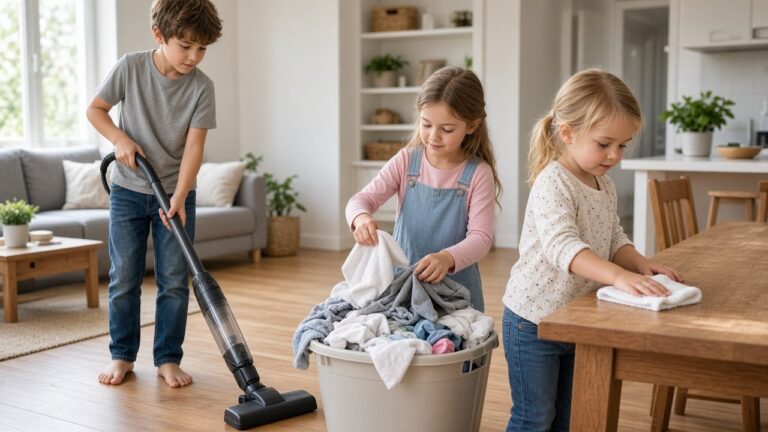
- Put toys into a bin or basket
- Carry a diaper to the trash or a sock to the hamper
- Hand you items while you unload groceries or the dryer
- Wipe a small spill with a cloth you hand them
- Put books back on a low shelf
- Throw away a wrapper with help
- Close a drawer you have opened
Around 2 to 3 Years
- Sort laundry by color into two piles
- Match socks (or at least find pairs)
- Put dirty clothes in the hamper at bath time
- Set napkins or unbreakable cups on the table
- Help feed a pet by pouring a measured scoop into the bowl
- Water plants with a small, half-full watering can
- Dust low surfaces with a sock on their hand
- Put shoes on a shoe rack by the door
- Carry their own plate (plastic) to the counter after meals
Around 3 Years
- Make the bed by pulling up a blanket or duvet
- Help unload unbreakable dishes and utensils (no knives) from the dishwasher
- Wash vegetables in a bowl of water
- Spray and wipe a table with water only
- Help carry light groceries in from the car
- Tidy their room with a picture checklist
Once a child moves past three, the jobs grow quickly. Our list of chores by age in the chore charts pillar picks up from there.

How to Teach a Toddler a New Chore
Teach a new chore by doing it together, slowly, in the same order every time, and letting your toddler take over one step at a time. Toddlers learn by watching and copying, so a short demonstration beats any explanation.
- Do it while they watch. Narrate in a few words: “Socks go in the basket.”
- Do it together. Put your hand over theirs or take turns: one sock for you, one for them.
- Let them do one step. You open the hamper; they drop the clothes in.
- Add steps over time. After a week or two, let them carry the clothes from the bedroom as well.
- Step back. Stay nearby, but let them finish even if it takes longer.
Break every job into the smallest pieces you can. “Clean up your toys” is too big for a two-year-old. “Put the blocks in the blue bin” is a job they can finish and feel proud of.

Set Up Your Home So Toddlers Can Help
A home that is set up for small hands makes it far easier to get toddlers to help around the house, because they can reach what they need without asking you every time. Montessori classrooms call this kind of work “practical life,” and the same ideas work well at home.
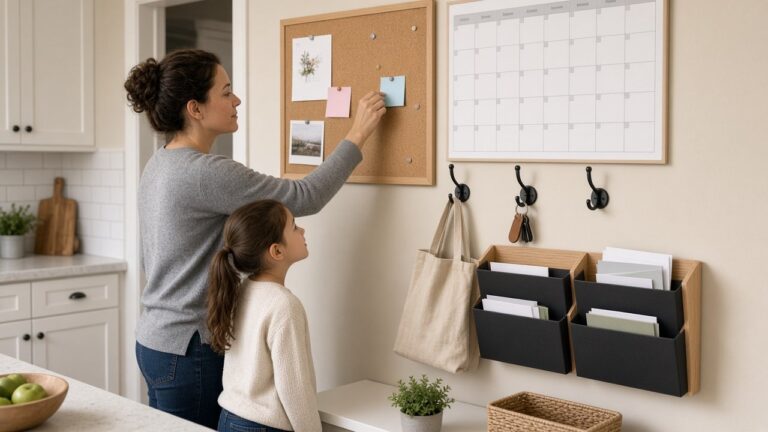
- Low hooks by the door for coats and bags.
- Open bins with a picture label for each toy type, so tidying means matching, not organizing.
- A low drawer in the kitchen with their plastic plates, cups and napkins.
- A small cloth or sponge kept where they can grab it for spills.
- Child-sized tools: a short broom, a small dustpan, a little watering can.
- A sturdy step stool with a rail for the bathroom sink or kitchen counter, used only with an adult in the room.
Fewer toys in rotation also helps. Ten toys in three bins are easy to tidy; a hundred toys in one big box are not.

What to Say to Get a Toddler to Help
The best words for toddler chores are short invitations and clear, positive directions rather than questions they can refuse. Asking “Do you want to clean up?” invites a “no.” Try these instead:
- Invite: “I’m going to fold towels. Come help me.”
- Offer a choice: “Do you want to carry the socks or the washcloths?”
- Make it a game: “Can you put all the red blocks in before the song ends?”
- Use first-then: “First toys in the bin, then we go outside.”
- Describe, then thank: “You put every book back. Thank you.”
Songs are surprisingly effective. Many families use the same short cleanup song every time, so the tune itself becomes the cue that tidying has started.

Make Chores Part of the Daily Routine
Toddlers help most reliably when chores happen at the same point in the day, attached to something that already happens, like meals, bath or bedtime. Routine means less negotiating, because the job is just “what we do after lunch.”
Simple anchors:
- After breakfast: carry cup to the counter, wipe the table.
- Before nap or quiet time: put books back on the shelf.
- Before dinner: set out napkins.
- At bath time: clothes into the hamper.
- Before bed: toys in bins, shoes on the rack.
A picture chart helps toddlers see what comes next long before they can read. Our step-by-step guide to a morning routine chart for kids shows how to build one with photos or simple drawings, and the same format works for a toddler’s cleanup steps.

Safety Rules for Toddler Chores
Keep toddler chores limited to safe materials and stay close by, because children this age put things in their mouths and cannot judge danger. A few basic rules prevent most problems:
- No cleaning chemicals. Toddlers can wipe with water and a cloth. Keep all cleaners, laundry pods and medicines locked up high. America’s Poison Centers runs the Poison Help line at 1-800-222-1222 for any suspected exposure.
- No sharp or breakable items. Leave knives, glass and ceramic dishes to adults.
- Watch the water. Use only a shallow bowl for washing vegetables and stay right there. Never leave a toddler alone near a bucket, tub or sink full of water.
- Stools with supervision. Step stools are for when an adult is in arm’s reach.
- Keep heavy loads light. A toddler carrying a full laundry basket can fall. Give them a few items instead.
- Stay away from hot surfaces. No helping at the stove, oven or with irons.
The AAP’s HealthyChildren.org site has room-by-room childproofing guidance that pairs well with these rules.

When Toddlers Refuse to Help
Toddler refusals are normal, and the best response is to stay calm, keep the job small and help them finish rather than starting a power struggle. Children this age are learning that they have their own will; “no” is part of that.
What tends to work:
- Shrink the task. “Just put in these three blocks.”
- Do it side by side. “I’ll do the cars. You do the trucks.”
- Offer a limited choice. “Bin or basket?”
- Check the timing. Tired, hungry toddlers rarely cooperate. Move cleanup before the meltdown hour.
- Let natural flow help. If toys are not put away, they may go on a high shelf until tomorrow, explained calmly, not as a punishment.
Avoid shaming or comparing siblings. If an older child is involved, our guide on how to divide chores between siblings explains how to make shared jobs feel fair across ages.

Accept Imperfect Help
Accepting imperfect help is the single biggest factor in keeping a toddler interested in chores. Socks will be mismatched, napkins will be crooked and the table will have streaks. If you redo the job in front of them, they learn their effort does not count.
Instead:
- Lower the standard for now. The goal is the habit, not the result.
- Fix quietly later if something really needs redoing.
- Plan for extra time. A two-minute job may take ten with a toddler. Start earlier when you can.
- Notice progress. Compare to last month, not to an adult.
It can help to remember why you are doing this. An often-cited analysis by University of Minnesota researcher Marty Rossmann, drawn from long-term family data, linked starting household tasks around ages 3 to 4 with better outcomes in young adulthood. Researchers caution that the study cannot prove cause and effect, but it matches what many parents see: kids who grow up pitching in tend to keep pitching in.

Keep Toddler Helping Going as They Grow
Toddler helping lasts longest when the jobs grow with the child and helping stays tied to being part of the family. As skills improve, swap easy jobs for slightly harder ones and give them a little more independence each month.
- Add a step to a job they already know.
- Give one “own” job, like feeding the cat each morning, that belongs to them.
- Use a simple picture chart with two or three pictures once they are around three.
- Keep saying thank you. Adults thank each other for help; kids notice.
When your child is ready for a bigger list, our guide on how to get kids to do chores covers the next stage, from preschool to the early school years.

Frequently Asked Questions

Frequently Asked Questions
What age can toddlers start doing chores? Many children start copying household jobs between about 18 months and 2 years. At this age chores are tiny and done with a parent, like putting a toy in a bin or a sock in the hamper.
What chores can a 2-year-old do? A 2-year-old can usually put toys away, carry clothes to the hamper, wipe a spill with a cloth, put books on a low shelf, set out napkins and help pour a pre-measured scoop of pet food with help.
Should I give my toddler a reward for helping? Praise and a thank-you work best for toddlers. A 2008 study by Warneken and Tomasello found that 20-month-olds who were given toys for helping later helped less once the rewards stopped.
How do I get my toddler to clean up toys? Keep fewer toys out, use labeled open bins, give one specific direction at a time, clean up together and use the same cleanup song or routine at the same time every day.
What if my toddler makes a bigger mess while helping? That is normal. Give them a smaller, safer part of the job, set up the space so spills are easy to wipe and focus on the habit rather than a perfect result.
Is it safe for toddlers to use cleaning products? No. Toddlers should use only water and a cloth. Keep all cleaners, laundry pods and medicines locked away and call Poison Help at 1-800-222-1222 if you think your child swallowed something.

The Bottom Line
Getting toddlers to help around the house works best when you go with their natural urge to copy you. Invite them into real jobs, break each job into tiny steps, give them safe tools at their height, thank them instead of paying them and accept that the result will be imperfect. A few small chores tied to meals, bath and bedtime are enough to start, and they lay the groundwork for the bigger jobs that come later.